
Are we ignoring half of Artificial Intelligence?

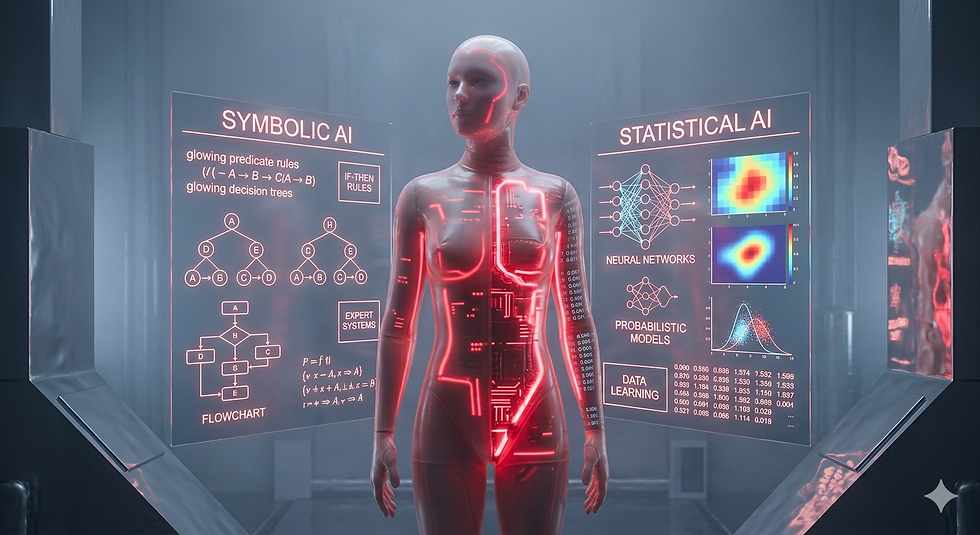
When most people hear "AI" today, they immediately think of ChatGPT, midjourney, or neural networks. But the world of AI is actually split into two massively powerful halves: Statistical AI and Symbolic AI.
If you only focus on one, you are missing out on how complex modern systems actually think.
Let's break down the difference using a simple educational analogy: The Chef vs. The Mathematician.
1. Statistical AI (The Intuitive Chef)
This is the AI behind Machine Learning and Deep Learning.
How it works: It doesn't learn rules. Instead, it looks at millions of data points (historical examples) to spot hidden patterns. It uses statistical probabilities to guess the next best move.
The Chef Analogy: Think of an experienced chef who cooks by "feeling." They don't measure ingredients or look at a recipe book. They tasted thousands of dishes in the past, so they just know intuitively that a pinch of salt will fix the soup.
Real-world Example: Generative AI models. They look at billions of words or images online, notice statistical patterns in human communication, and generate shockingly human-like text or art.
2. Symbolic AI (The Strict Mathematician)
This is the AI behind Automated Planning, logic engines, and graph solvers
How it works: It doesn't use training data or experience. Instead, it operates purely on exact logic, strict rules, and hard facts. You give it a starting point, a goal, and the mathematical rules of the universe, and it calculates a perfect path.
The Mathematician Analogy: Think of a pure mathematician solving a complex calculus proof. There is no guessing, no intuition, and no "feeling." Every single step must strictly follow a mathematical law. If a rule is broken, the entire calculation fails.
Real-world Example: Mars Rover navigation or robotic factory assembly line scheduling. If a robot is packing precise medical supplies, you cannot afford statistical "hallucinations" or guesses. You need 100% mathematically proven accuracy.
The Takeaway: Which one is better?
Neither!
They are designed for completely different jobs:
Statistical AI thrives in messy, creative, and fuzzy environments (like recognizing a face in a crowd or drafting an email).
Symbolic AI thrives in high-stakes environments governed by strict rules (like logistics routing, financial auditing, and automated engineering).
In fact, the absolute cutting edge of computer science research is called Neuro-Symbolic AI—a hybrid approach that combines the intuition of Statistical AI with the bulletproof logic of Symbolic AI.
The next time you build or evaluate an AI tool, ask yourself: Do I need a chef who cooks by intuition, or a mathematician who calculates with absolute certainty?
Comments