
India doesn’t have an AI adoption problem. It has an AI trust and scaling problem.

Two recent reports on enterprise AI in India reveal a paradox that CEOs, CTOs and Boards should pay close attention to.
India’s enterprise AI investment surged 119% in a single year, compared with 110% globally.
AI already consumes 16.6% of the average IT budget, and that is projected to reach 21.3% by 2027.
Yet only 22% of Indian enterprises have testing, auditing and risk-assessment processes in place.
Even more revealing:
• 54% are deploying AI agents
• Only 11% have moved to autonomous workflows
• Only 18% have replaced fragmented legacy systems with integrated platforms
• 74% say data accuracy, access and management need significant improvement
• 56% identify legacy-system integration as a major challenge
And this isn't just an India problem.
Another recent enterprise AI study found that only 22% of organisations globally have successfully scaled AI across business units.
So we have a strange situation:
AI investment is scaling faster than AI maturity.
Companies are moving from copilots to agents, but the governance, testing, data and operating foundations required to trust these systems are not keeping pace.
This becomes particularly dangerous as AI moves through three stages:
AI recommends → AI decides → AI acts
The risk changes completely when an AI system is no longer simply generating an answer but taking an action that affects customers, money, compliance or reputation.
This is where I believe the next phase of enterprise AI needs a different architecture.
From Generative AI to High-Trust AI
Traditional AI governance often relies heavily on policies, documentation and human review.
That isn't enough for autonomous and agentic systems.
We need deterministic governance around probabilistic intelligence.
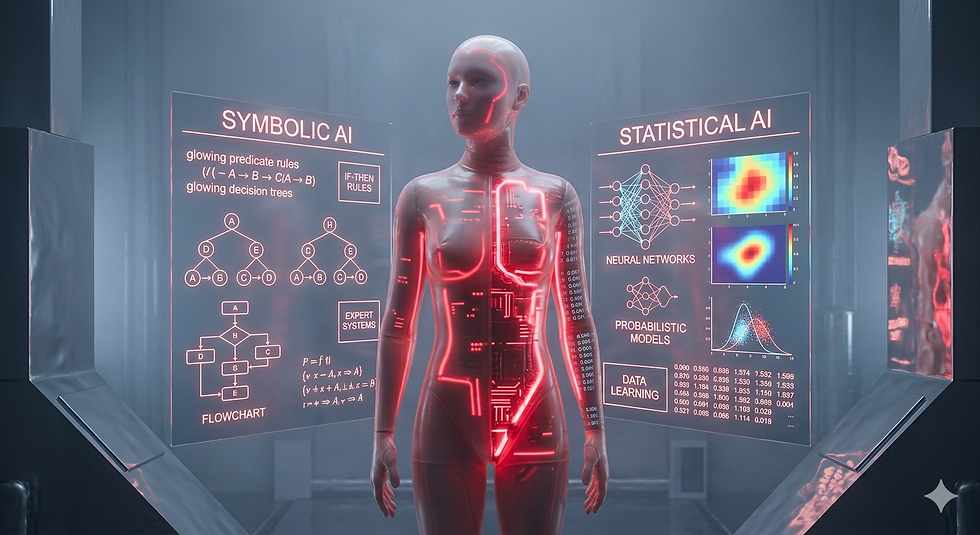
This is where I see Neuro-Symbolic AI becoming particularly important.
The neural layer provides:
Reasoning | Prediction | Adaptation | Natural-language intelligence
The symbolic layer provides:
Rules | Policies | Constraints | Permissions | Auditability | Deterministic controls
Together, they create something enterprises increasingly need:
High-Trust AI
AI that is not only intelligent, but also:
Explainable.Auditable.Policy-aware.Testable.Controllable.Accountable.
For CEOs and Boards, the question shouldn't simply be:
"How many AI use cases have we deployed?"
The more important questions are:
Can we trust the decisions AI is making?
Can we prove why an AI agent took an action?
Can we prevent an agent from taking an unacceptable action?
Can we continuously test AI after deployment?
Can we measure business value—not just AI usage?
And ultimately:
Can we scale AI without scaling enterprise risk at the same time?
The next competitive advantage in AI may not come from having access to a better model.
It may come from building the operating system of trust around AI.
India is investing heavily in AI.
The next challenge is making that AI safe enough to scale, measurable enough to manage, and trustworthy enough to delegate decisions to.
That, in my view, is the real transition from AI adoption to AI maturity.

Comments